
Refillable Sample to Bulk: The Handover Points That Move Unit Cost
Unit cost is not fixed when the sample is approved; it is fixed when the approved sample is transferred to the production line. That transfer is where dosing changes, where the refill closure is set for the first time at speed, and where a specification that existed only in a laboratory notebook has to become a document the line can follow. A brand that treats the handover as an administrative step usually pays for it in rework, scrap and a slower first run.
Key takeaways
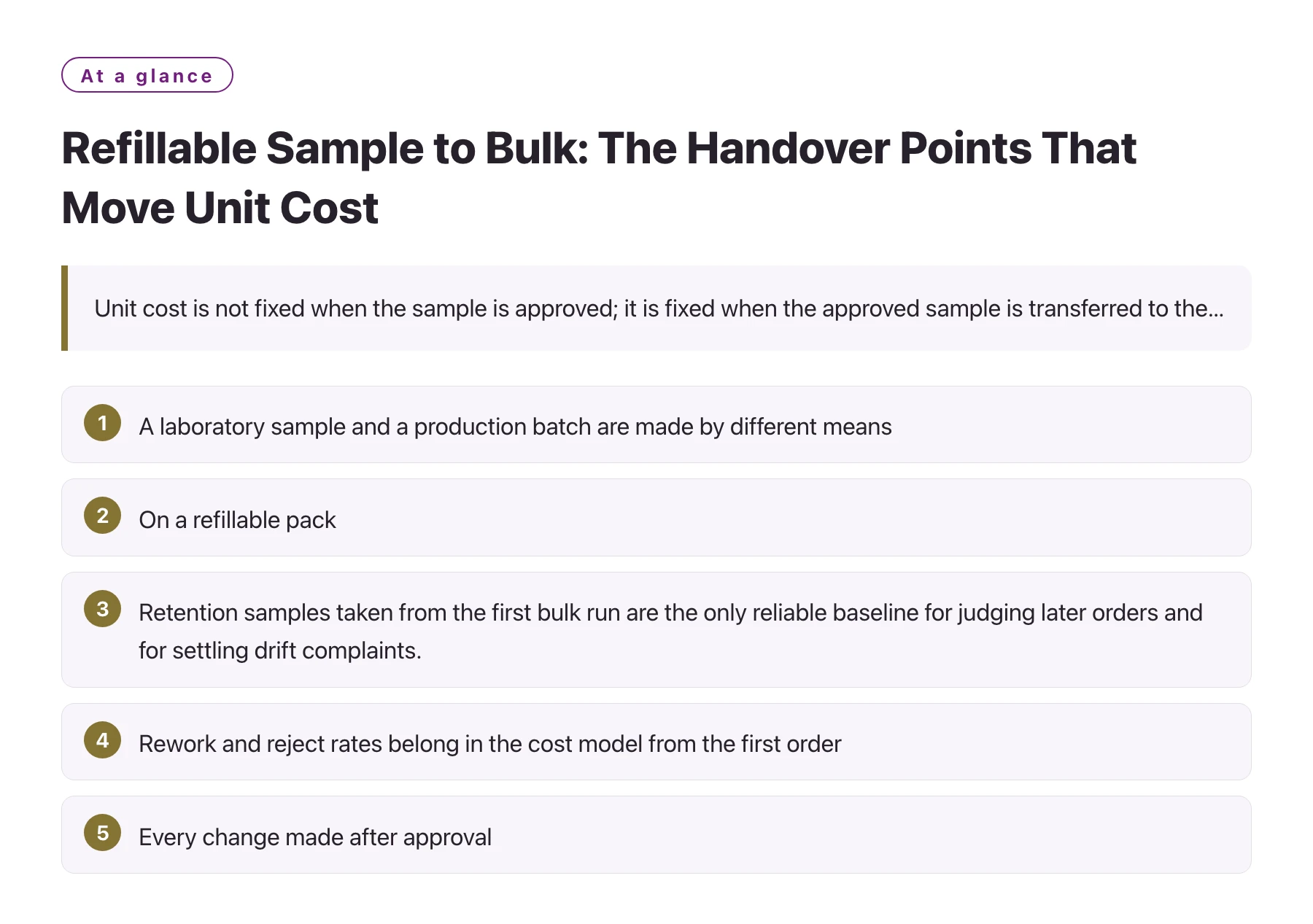
- A laboratory sample and a production batch are made by different means, so the approval should specify what must stay identical and what may vary within stated limits.
- On a refillable pack, closure torque, fill weight and seal integrity are the handover settings most likely to move unit cost.
- Retention samples taken from the first bulk run are the only reliable baseline for judging later orders and for settling drift complaints.
- Rework and reject rates belong in the cost model from the first order, because they are the difference between a quoted price and a paid one.
- Every change made after approval, however small, should be recorded with its reason so that cost consequences can be traced.
A sample is a promise made under favourable conditions. It is weighed by hand or made in small equipment, checked by the people who developed it, and stored carefully until it is presented. Production is the same product made under time pressure, by different operators, on equipment that fills thousands of units an hour.
For a refillable line the gap is wider, because the pack has moving parts that have to seat correctly on every unit. This article follows the handover in the order it happens and identifies where cost is added, held or lost.
The approval document is the first cost decision
When a brand approves a sample, it is approving an object, not a specification. The consequence appears weeks later when the bulk arrives and smells slightly different, or when the refill does not seat with the same resistance. Both outcomes are avoidable if the approval records three things: the formula reference, the acceptable range for the parameters that matter, and the pack components by their own references.
The parameters that matter should be chosen deliberately. Fill weight tolerance, closure torque and seal performance are the ones that translate directly into complaints on a refillable product. Colour and odour of the concentrate are usually specified too, but they are assessed against a retained reference rather than described in words, because words do not settle a dispute.
Ingredients themselves are documented in public registers that list functions and restrictions, which makes it possible to write a specification that a third party can check later [1]. A specification built on names and numbers survives a change of personnel on either side; one built on adjectives does not. The service scope a manufacturer publishes, such as the one set out at www.xuelei.com/, is a reasonable starting point for writing that specification, though it is not a substitute for one.
The three settings that decide whether bulk cost matches the quote
Fill weight and the shape of the tolerance
Filling equipment delivers a distribution, not a single figure. If the specification demands a very tight range, the line runs slower and rejects more, and both effects appear as cost. If the range is loose, a portion of the batch sits outside the declared fill volume, which is a consumer and, in some markets, a labelling problem.
The workable approach is to agree a tolerance that the line can hold comfortably and to state how many units may fall outside it. That is a quality decision with a price attached, and it should be made with the supplier rather than imposed after the pilot run.
Closure torque and seal performance on the refill
A refill closure that seals perfectly when tightened by hand can leak when tightened by a machine set a fraction too light, and can crack a collar when set too heavy. Setting that parameter is a production engineering task, and it is the point where the pack ceases to be a design and becomes a process.
This is also where a change of component supplier is felt first. A new closure mould, even to the same drawing, can shift the torque that gives a reliable seal, which is why the pack specification should name the component and its source rather than describe the appearance.
Retention samples and the baseline they create
The first bulk run should produce retention samples, stored under stated conditions and labelled with the batch record. Without them, a later complaint about drift can only be argued from memory. With them, the comparison is physical: the same assessment, by the same method, on two retained units.
Retention samples also make reformulation visible. When a material is restricted or discontinued, the replacement changes the formula, and the documentation from the approved version is what allows the change to be assessed properly [2]. Suppliers differ in how they store and how long they keep these references, and the question is worth asking before the first order rather than after. The most common causes of divergence between a retained unit and a later batch are set out in this explanation of why a sample and the bulk order can differ.
Where the money actually goes during handover
Handover cost is rarely a single large item. It is a set of small ones: a slower first run, units rejected at the seal check, a batch held while a discrepancy is investigated, and the labour spent resolving it. None of these appear in a unit price built from ideal conditions, and all of them appear on the invoice if the specification was vague.
Safety assessment is a related cost that is easy to defer and expensive to rush. Independent scientific advice on substances used in cosmetics is published at European level, and it defines limits that a formula has to respect [3]. A brand that commissions its safety documentation at the sample stage avoids paying for it twice when the bulk changes.
There is a contractual dimension too. Formula references, pack drawings and process parameters are assets, and how they are protected and transferred when a relationship ends is a matter of intellectual property practice rather than goodwill [4]. Recording them clearly during the handover costs nothing and prevents a difficult conversation later.
One habit ties these together. Keep a change log from the moment of approval, with a line for every alteration to formula, pack or process, the reason for it and the date it was agreed. It converts the handover from a memory of meetings into a record that can be read by anyone who joins the project afterwards.
For brands comparing suppliers, this is a fair question to put in writing: describe the handover from approved sample to first bulk run, and tell me what you record. The answer separates suppliers who run a process from those who run a laboratory. It also explains why certification and process background are worth checking before a first order is placed: the certificates behind its background and certifications should be available as documents rather than as claims.
If the approval document describes the sample rather than the specification, the handover has no baseline. Fix that before the first bulk run, not after the first complaint.
Sources
- EU CosIng — Cosmetic Ingredient Database (European Commission) —— The European Commission's CosIng database of cosmetic ingredients, listing ingredient functions, restrictions and labelling requirements under EU cosmetics law.
- IFRA: Safe Use and Fragrance Science —— IFRA's explanation of how fragrance materials are scientifically assessed for safe use and how those conclusions are applied by the industry.
- EU Scientific Committee on Consumer Safety (SCCS) —— The EU scientific committee that issues opinions on the safety of cosmetic ingredients, including fragrance allergens and their labelling thresholds.
- WIPO — World Intellectual Property Organization —— The UN agency for intellectual property; resources on industrial design and patent protection relevant to product and packaging design.
Frequently asked questions
Why does a bulk order sometimes smell different from the approved sample?
The concentrate may be weighed differently at scale, materials may come from a new batch, or the product may simply have had less time to rest. A retained reference sample and a stated assessment method are how the difference is measured rather than debated.
What is a retention sample and why does it matter?
It is a unit kept from a production batch under stated storage conditions. It is the physical baseline for judging later batches and for investigating a complaint about drift.
Which refillable parameters should be fixed at approval?
Fill weight with a tolerance, closure torque, seal performance, and the component reference for the refill vessel and its closure. These are the settings that most often cause leaks or returns.
Do rework and rejects belong in a cost model?
Yes. A quoted unit price assumes a yield, and the actual cost depends on the reject rate. Ask what yield the price assumes and how rejected units are charged.
Can a brand change the pack after the first bulk run?
It can, but the change invalidates part of the testing and usually requires a new qualification round. The cost is lower when the change is made before the pilot run than after the first commercial batch.
Обсудим ваш проект?
Инженер Domostroi приедет на участок, проведёт замеры и подготовит прозрачную смету без скрытых доплат. Один менеджер — один договор — один срок.